Africa–Germany Business Relations
We asked senior managers at German companies working in Ghana, Kenya, Nigeria and South Africa how they see their markets.

First published by Friedrich Naumann Foundation for Freedom on 16 Nov 2026.
In this publication
Executive Summary
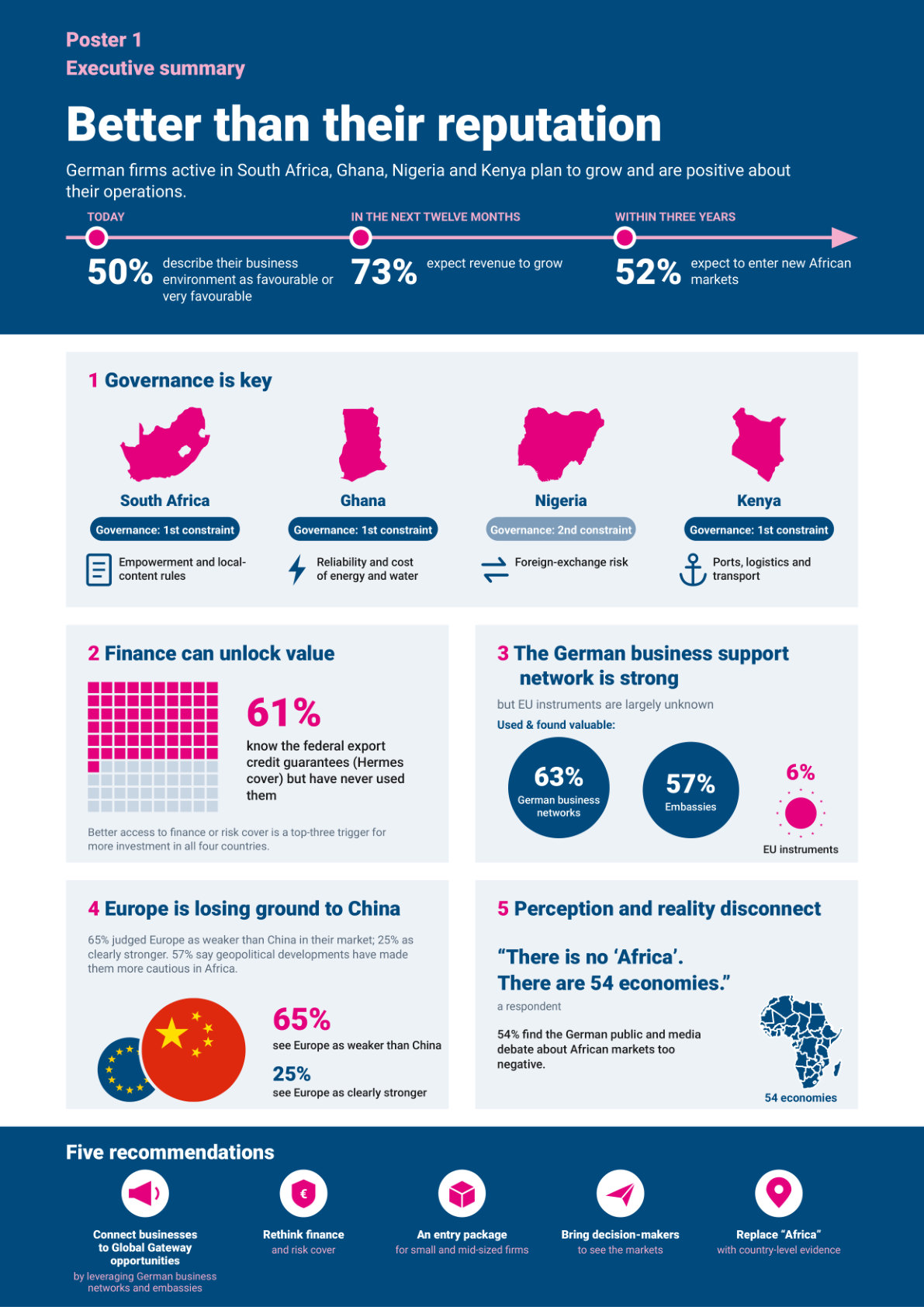
German businesses have been present in Africa for decades, and many German brands are household names across the continent. Yet how German firms see African markets often weighs as heavily in their decisions as the facts and figures do. This study asks how German businesses active in South Africa, Ghana, Nigeria and Kenya perceive these markets today: what is working, what holds them back, and how Europe's offer compares with that of China, the Gulf states, Turkey, India and the United States. The study draws on a survey of senior representatives of German businesses based in Germany and in the four countries. The study drew the following number of respondents South Africa – 20, Kenya – 24, Nigeria – 20 and Ghana – 18, across several sectors, including Energy, infrastructure and construction Services, ICT and digital, and Manufacturing, machinery and industrial equipment.
The picture that emerges is one of confident firms in markets that are better than their reputation. Half of respondents describe their business environment as favourable or very favourable, and only 8% as unfavourable. Most say their markets performed as expected or better. Nearly three quarters (73%) expect revenue to grow in the next twelve months. Half plan to expand their existing business in the coming year, and 52% expect to enter new African markets within three years. For most firms, Africa is still a modest share of global revenue, indicating that there is room to grow.
The survey also shows clear obstacles, and the means to address them:
1. Governance is key, as corruption and governance concerns are the first constraint in South Africa, Ghana and Kenya, and the second in Nigeria. Each market also has a constraint of its own:
- empowerment and local-content rules in South Africa;
- the reliability and cost of energy and water in Ghana;
- foreign-exchange risk in Nigeria;
- ports, logistics and transport in Kenya.
2. Finance has the potential to unlock value, as better access to finance or risk cover is among the top three triggers for more investment in all four countries. Yet 61% of respondents know the federal export credit guarantees (Hermes cover) but have never used them, indicating the potential for change.
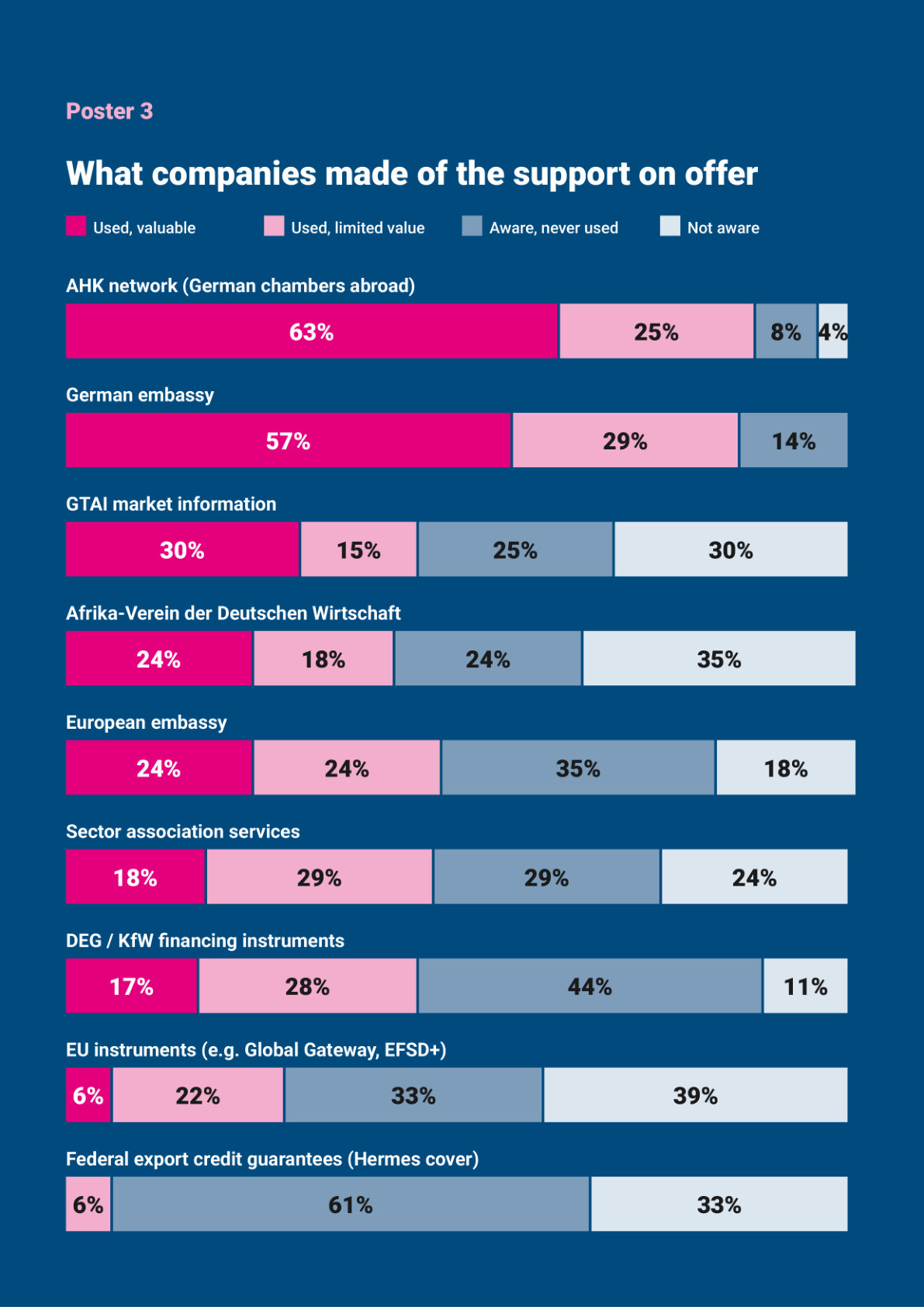
3. Trust for German businesses exists in German channels as the EU's offer is barely known. 63% of respondents found the German chambers of commerce abroad (AHK) valuable, and 57% the German embassies. In contrast, 39% were not aware of EU instruments such as Global Gateway and the European Fund for Sustainable Development Plus (EFSD+). Only 6% had used these and found them valuable. Critical here is in-person due-diligence, for German businesses to gain a deeper understanding of current and potential markets.
4. Europe is losing ground to China, as 65% of respondents judged Europe as weaker than China in their market. Against India, Europe is more often seen as weaker than stronger. Views on the United States, Turkey and the Gulf states are more evenly split. This in the broader context where 57% of respondents say that geopolitical developments have made them more cautious in Africa.
5. There is a disconnect between perception and reality for many German businesses. 54% of responses find that the German public and media debate about African markets is too negative, and fewer than a third find it accurate. In their open answers, respondents repeatedly reject the idea of "Africa" as one market: "There is no 'Africa'. There are 54 economies." This growing awareness and change is positive.
Policy is seen in mixed ways where African integration is viewed positively with 65% of respondents expecting the African Continental Free Trade Area to have a positive impact on their market. EU rules are mostly seen as neutral, or respondents do not know them.
These include:
- the Carbon Border Adjustment Mechanism;
- the due diligence rules (the German Supply Chain Act and the EU directive);
- the Deforestation Regulation.
When respondents were asked what Germany and the EU should prioritise, respondents named:
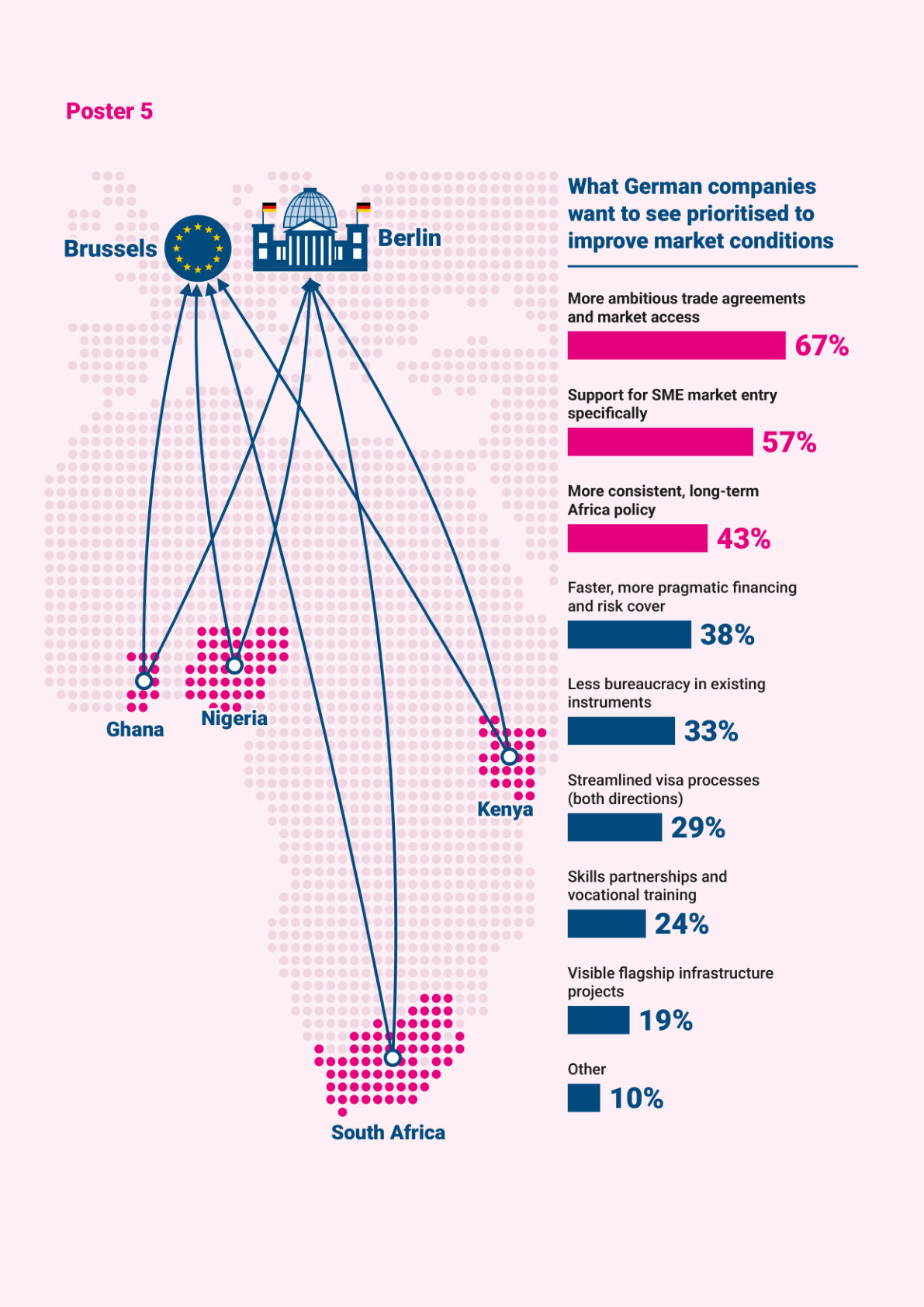
- more ambitious trade agreements and market access (67%);
- support for SME market entry, meaning small and medium-sized companies (57%);
- a more consistent, long-term Africa policy (43%).
The study makes five recommendations:
- Make the Global Gateway Initiative visible to business through the channels firms already trust, namely the AHK network and the embassies, with project and tender pipelines attached.
- Rethink finance and risk cover with simpler guarantees, local-currency lending, and guarantee components for local banks.
- Build a practical entry package for small and medium-sized companies, including matchmaking with vetted local partners.
- Invite German decision-makers to see the markets for themselves through short visits that are specific to one sector and one country.
- Replace the single "Africa" narrative with country-level evidence and stories, by developing short risk-and-opportunity briefs and success stories for each market.
The German firms active in these four markets plan to grow and are positive about their operations. The task for German and European policy is to make the instruments built for these businesses known, usable and bespoke to each country, and for the country narratives to match the practical experience on the ground.
1. Introduction
The overall objective of this research is to support the advancement of business partnerships and cooperation between African and European business communities, by investigating what is working, what requires improvement and what opportunities/barriers exist. This research focuses on four Sub-Saharan African countries – South Africa, Ghana, Nigeria and Kenya. These represent a geographic spread of South, East and West Africa, as well as being seen as fairly large and stable economies in their regions.
We deliberately focus on ‘sentiment’, for two reasons. Firstly, as we will show and as is widely understood, the perception of African markets often speaks louder than the facts and figures. And secondly, because we stand in good company and aim to support the work of our fellow think tanks and business chambers, and not to duplicate these efforts. For example this work compliments the recent Friedrich Naumann Foundation’s South Africa Germany Trade Relationship and the 2026 German- Southern African Business Outlook, published by the German Chamber of Commerce and Industry for Southern Africa (AHK Southern Africa) and Germany Trade and Invest (GTAI).
Below we present outcomes related to perceptions of selected themes in African/European business cooperation broadly, and German-Kenyan/ Nigerian/ Ghanaian/ South African cooperation specifically. The study aims to provide an evidence-based, accessible overview of how German business perceives the African business environment, aiming to capture the geopolitical layer from the firm's perspective: awareness and assessment of the Global Gateway Initiative and how the European offer compares, as experienced in the market, with that of China, the Gulf states, Turkey, India and the United States. We hope that these findings support concrete decision making, inform recommendations for German business, FNF and policy stakeholders.
The report serves four audiences: the German business community, as a practical reference on doing business in Africa; policy stakeholders in Berlin and Brussels, as evidence to inform German and EU policy; African governments and policy makers, as a roadmap to incentivise FDI, and media, as a substantive foundation for reporting on Germany-Africa business ties. For Meridian17, the study additionally pilots the methodology and respondent panel for the broader Beat of Business programme.
2. Germany-Africa Economic Relations
Setting the Scene
Germany has held a strong position in the African continent, and has developed established business partnerships over many decades. In many cases German brands are ‘household names’ in African markets (African Business, 2024).
The EU almost tripled its Global Gateway commitment to South Africa in October 2025, from R4.7bn to almost R12bn (Moakes & Berkowitz, 2026), and South Africa, for example, has been labelled a ‘strategic partner’ of Germany. Given Africa’s broader strategic importance for Germany’s export market and achieving global climate goals, coverage for African projects should be made easier (Afrika Verein, 2026).
The EU’s intensified focus on Sub-Saharan Africa is due to a shift, as “Africa has become the centre of [the EU member states’] development cooperation”, as the EU does “not have traditional ‘partner countries’ in Latin-America or Asia anymore (Sherriff and Veron 2024, in Bougrea, 2025). According to Sililo (2026, personal communication) “you have to take a look at the dynamic of the African markets, where you see considerable potential, considerable growth, .. if you look at the most recent numbers”. This is part of the reason why “Germany and the EU are investing in new partnerships and broadening existing ones with many countries in Africa” (Scholz, 2023).
Looked at in a broader global perspective in terms of markets and population growth “only sub-Saharan Africa still has high fertility, and rates are declining even there.” (Beckley, 2025: NP). Yet this upside is tempered by the fact that across many African countries, “savings and investment have collapsed, and youth unemployment tops 60 percent in some countries. These pressures are fuelling turmoil: roughly a third of African states are in active conflict” (Beckley, 2025: NP). African markets – like many of their counterparts across the world, represent an imperfect picture, yet the rewards of doing business remain.
Gaining a clear picture of the operating landscape can be difficult, as studies have suggested “that risk perception in development finance carries a racialized undertone (Collier and Pattillo 2000), with [Sub-Saharan African] nations often unfairly labelled as “atypically risky,” a view not entirely reflective of typical investor wariness (Alami and Guermond 2023; Haque, Nadeem, and Mathieson 2000, in Bougrea, 2025).
According to Butek & Tala (2026:27), the trade relationship between Germany and many of its Southern African counterparts has been “volatile over the past decade”. Of course this is in a volatile period, shaped by trade wars, the Covid-19 pandemic, instability in parts of the African continent, changing political winds in Europe (Erlanger, 2026) and “pronounced commodity price cycles rather than structural shifts in the relationship” (Butek & Tala, 2026:27). Their study finds cautious optimism regarding German businesses’ revenue and profits, with South Africa as the regional anchor, while investment stays subdued because of policy and regulatory uncertainty, B-BBEE requirements and infrastructure and skills constraints (Butek & Tala, 2026).
Brief Country overview:
Nigeria is the continent’s fourth largest economy (Okpi, 2025). For the BMZ (2026) “the overarching goal of Germany's development cooperation with Nigeria is to create employment and a better future for the country's population, which is very young”.
According to the BMZ (2026:n.p.) “Democracy is well established in Ghana and … is the second largest economy in West Africa”, with strong macroeconomic performance and projected Real GDP growth of 5,7% in 2026 (IMF, 2026). “Germany is one of Ghana’s most important development partners” (BMZ, 2026)
South Africa “is one of the “global partners” of the Federal Ministry for Economic Cooperation and Development (BMZ). (BMZ, 2026) and they note that “Over the past 30 years, South Africa has developed into a stable democracy” (BMZ, 2026).
Kenya is “an established democracy and driver of economic growth, is making key contributions to stability and development in East Africa” (BMZ, 2026: n.p). “Germany is one of Kenya's biggest supporters. The two countries' cooperation is geared towards facilitating economic development, achieving sustainable poverty reduction, and reducing social inequalities” (BMZ, 2026). “East Africa’s biggest economy has been expanding steadily by around 5% in annual terms in the past few years” (Obulutsa, 2026, n.p.)
Germany’s Place in Africa’s Global Connections
The DHL Global Connectedness Index, produced by DHL with NYU Stern, scores how deeply and broadly each economy is linked to the rest of the world through four kinds of cross-border flows: trade, capital, information and people. Below we share the maps for each of the five countries we cover – Germany, South Africa, Ghana, Nigeria, and Kenya.
According to Altman & Bastian (2026: 113) “these maps [presented below] highlight both the countries that are most connected to the profiled country (using sizes) and the countries for which connections to the profiled country are most salient (using colours)”.
We present this data to provide a broader indication of the positioning of the various countries in this study, and where Germany sits among them. Depth is how much a country connects internationally compared with its own domestic activity. It asks how large its cross-border flows of trade, capital, information and people are relative to its economy (Altman & Bastian, 2026). Breadth is how widely those flows are spread across partner countries. It asks whether the connections are concentrated in a few partners or spread around the world. (Altman & Bastian, 2026)
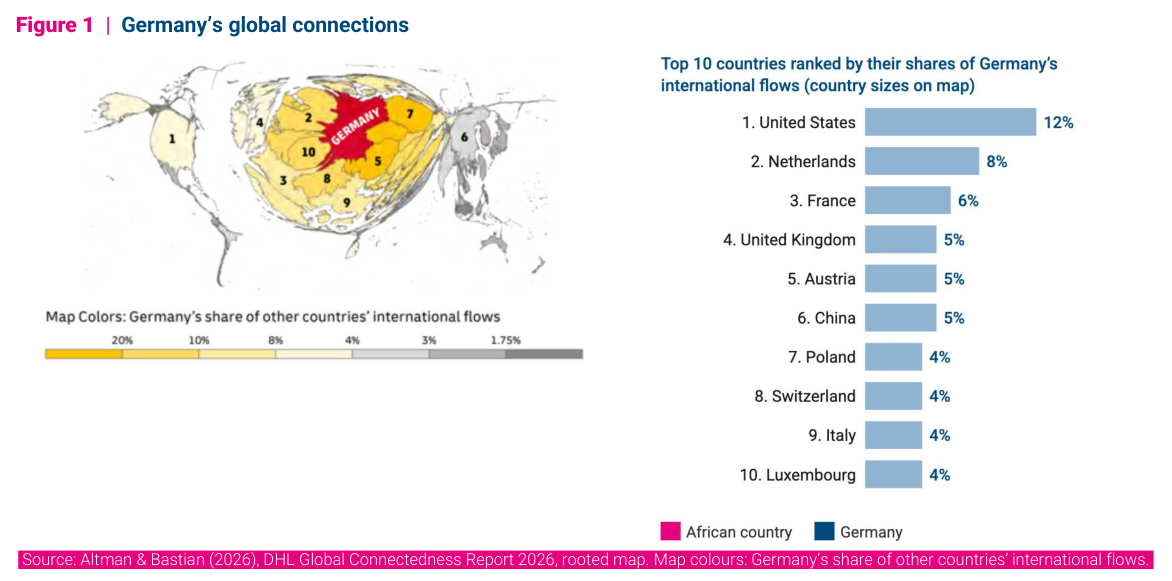
Germany, unsurprisingly is deeply tied to EU countries, as well as the United States (US) (a top partner not only for Germany, but also for Ghana, South Africa and Kenya. The US is the second largest connection for Nigeria). African countries do not feature for Germany as key trading partners.
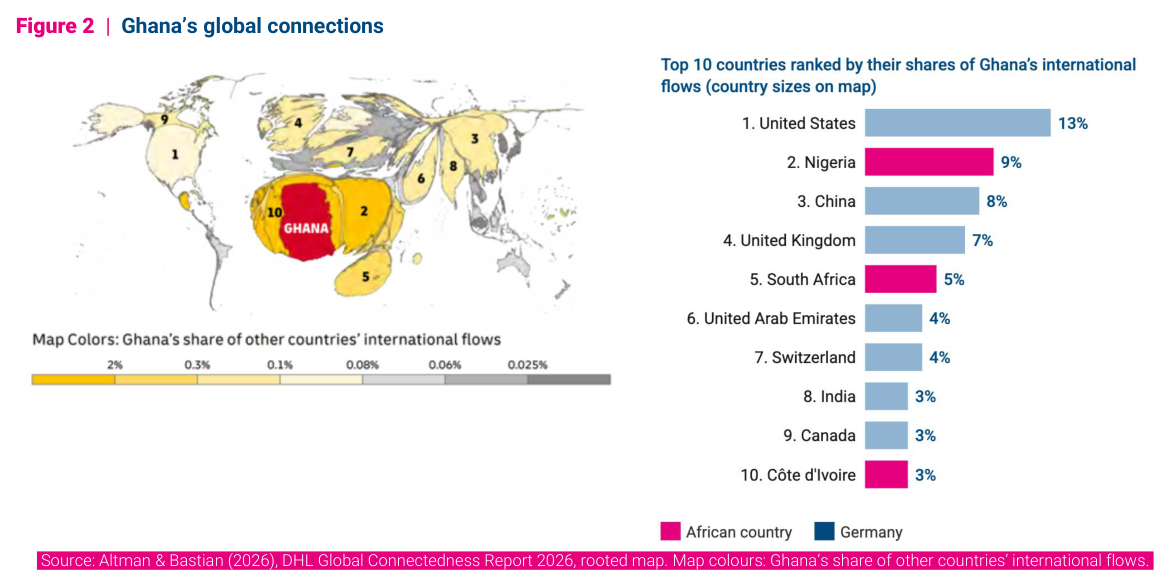
Ghana’s top global connections include Nigeria at 2nd place and South Africa at 5th place. There is no clear link with Germany or the EU in this market, indicating that there is room to grow and further strengthen this relationship.
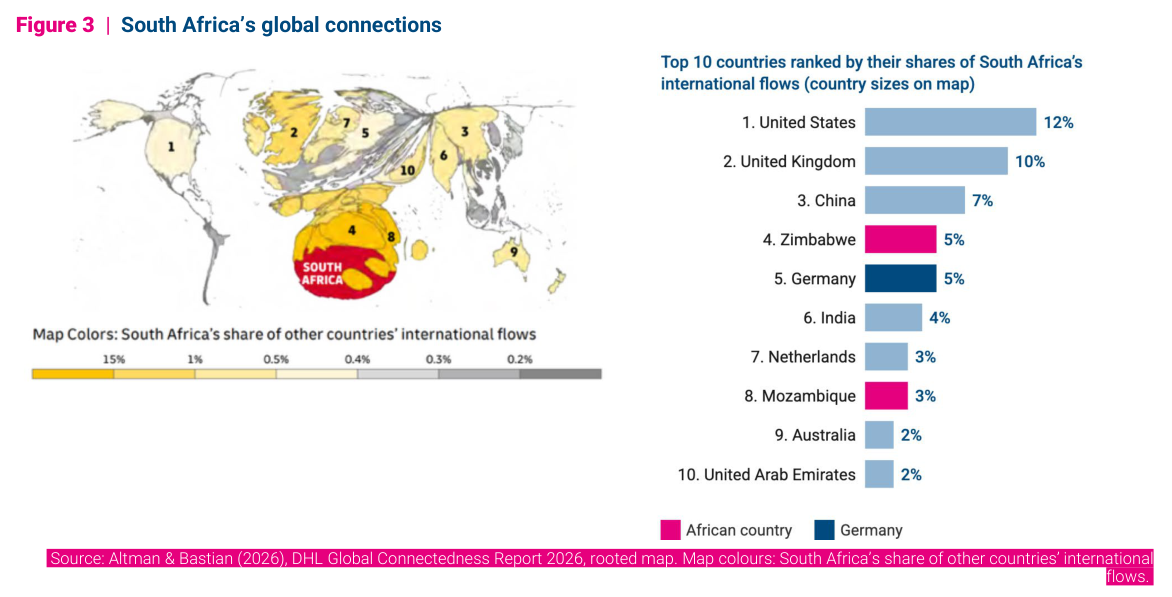
Reviewing South Africa’s connections, Germany is the 5th most prominent partner, and the first EU country to feature, below the US, United Kingdom and China. None of the other African countries in our research sample feature for South Africa, but South Africa is listed in each of the other three African countries -Nigeria, Ghana and Kenya.
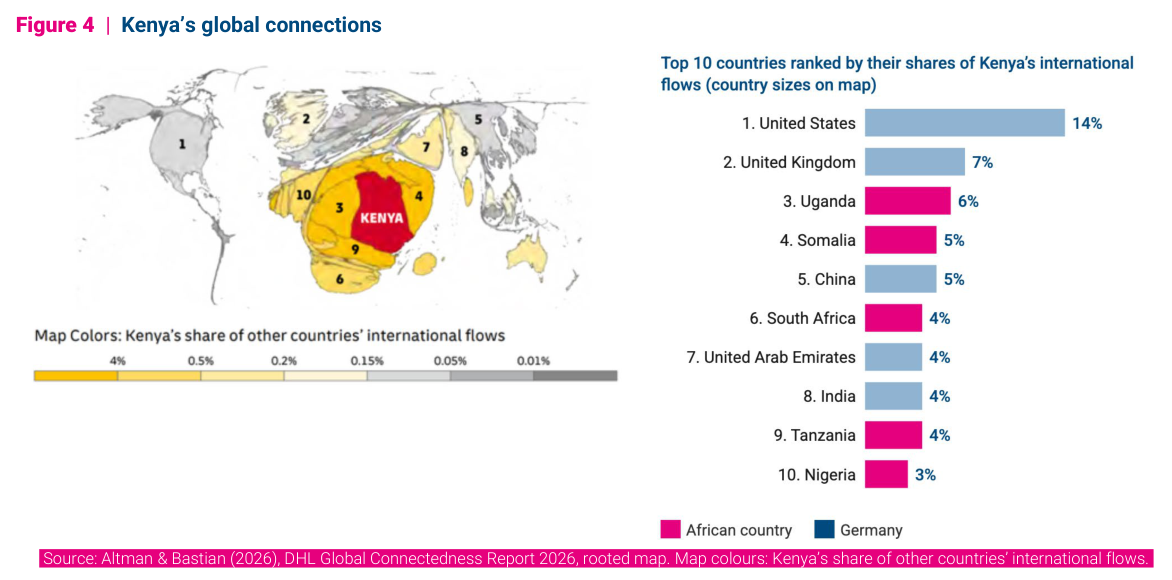
Kenya is connected to several other African countries, including Uganda, Somalia, and Tanzania, and with South Africa and Nigeria represented at 6th and 10th position.
Germany does not feature for this market. Kenya has the largest number of African countries in its connections list.
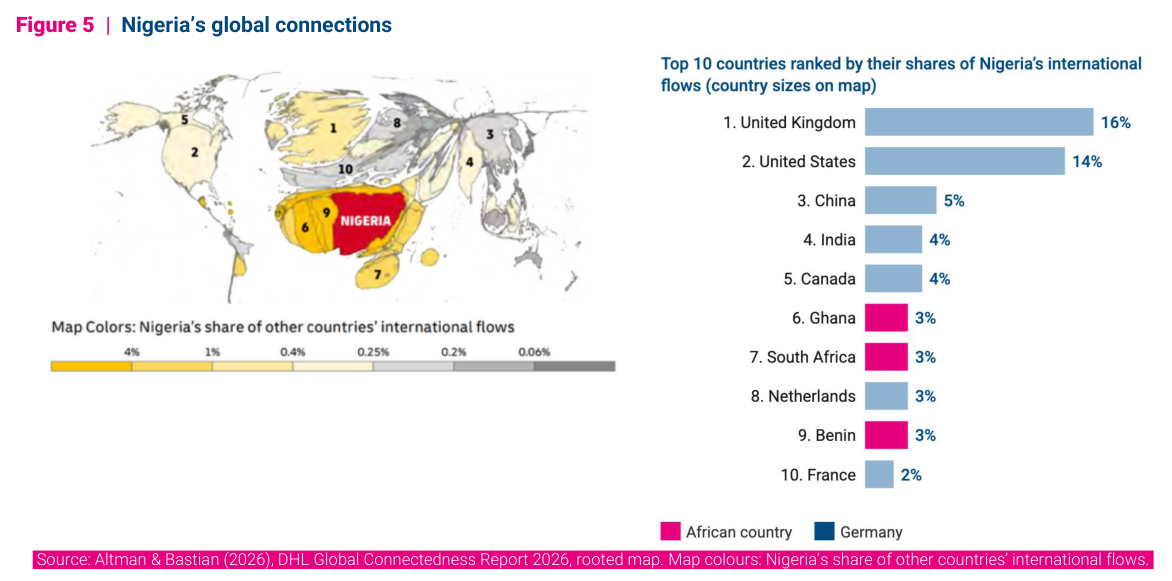
Nigeria is connected to both Ghana and South Africa, but not to Kenya, or Germany. The UK, US, China, India and Canada are all more prominent partners than Ghana – the first African country that features. In this sense Nigeria is the only country in the sample to have no African peers in the top 5.
3. Methodology
We shared the survey with 120 potential respondents contacted via LinkedIn and 248 direct requests via email, in addition to hosting a link to the survey on our website, and received answers as per the following: South Africa – 20, Kenya – 24, Nigeria – 20 and Ghana – 18. In addition to this we conducted an expert interview for additional context, with an expert based in Germany working actively at the interface between German businesses and African businesses and policy.
The population of focus was representatives of German businesses, based in either Germany or one of four African countries – South Africa, Kenya, Ghana or Nigeria. We sought respondents in roles like CEO, Business Development Manager, Market Development Manager, Founder, Head of Middle East & Africa, Member of the Board, Managing Director, Area CEO Africa.
Respondent demographic profile
Respondents represented Energy, infrastructure and construction (24% of respondents), Services, ICT and digital (21% of respondents), Manufacturing, machinery and industrial equipment (12% of respondents) and then ‘Other’ – including Logistics, Shipping & Automotive, Healthcare and, Education. 58% of respondents being active on the continent for 6 years or longer.
4. What businesses shared
In this section we present the findings from the survey, before moving to analyse them in Section 5 below.
By and large, the African markets did not represent a significant proportion of the organisation’s total revenue.
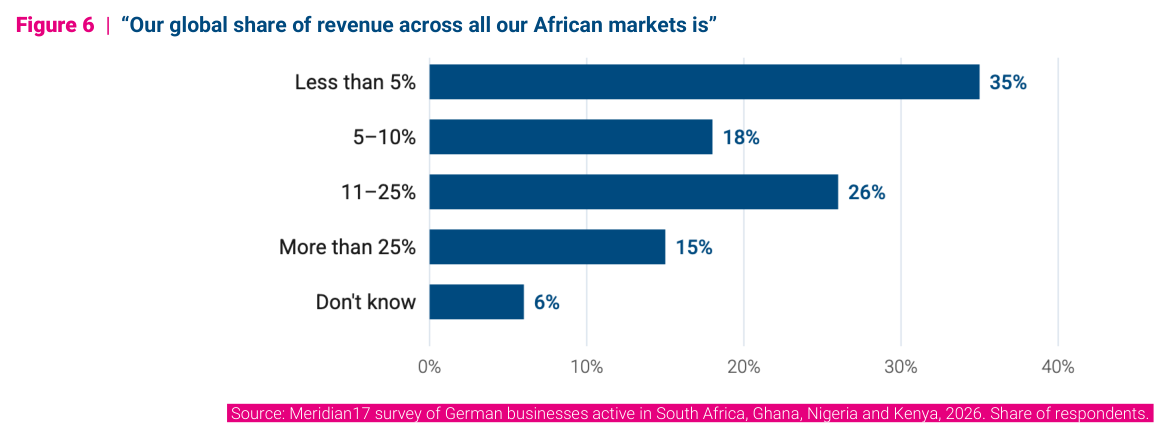
In answer to the statement. “Our global share of revenue across all our African markets is”, we saw that 35% of respondents noted ‘less than 5%’ 18%. Noting 5-10%, 26% between 11-25% and 15% more than 25%. Therefore 44% of respondents fall into the 5 – 25% bracket.
Respondents reported that their markets had performed either largely as expected, or well above expectations. With only 6% of respondents indicating performance was below expectations and none reporting ‘well below expectations’.
Looking to the future, in answer to the questions “In the next 12 months, we expect revenue in our market to” and “In the next three years in our market, we expect” we saw a positive outlook from respondents. 26% of respondents expected revenue to remain stable in the coming 12 months, while a combined 73% expected that there would be an increase in revenue in that period (47% - moderate increase and 26% a significant increase). Similarly no respondent expected divestment or a reduction in their operations in the coming three years, with 7% indicating no planned investment, while respondents were otherwise spread between maintenance and smaller investment/expansion (a combined 28%) and 65% combined respondents indicating moderate or significant expansion.
In response to the statement, ‘the business environment in our African markets is’, half of respondents noted that it was either favourable or very favourable, with 42% noting it was neutral, 8% unfavourable, and none selecting very unfavourable.
4.1 Constraints and opportunities, as seen by business
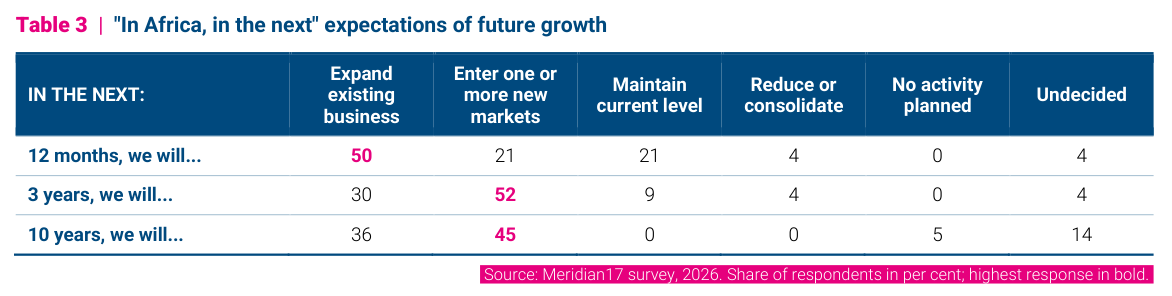
Looking to the future, half of the respondents expected to expand their business in the coming 12 months and to grow into new markets in the coming three years. In the coming ten years, it was more likely for respondents to expect to enter new markets (45%), than to expand their existing business, yet 36% of respondents still planned expansion over this time horizon.


4.2 Media, narrative and information
When asked to reflect on whether the “German public and media debate reflects the reality in African markets”, just under 30% noted it was accurate, while 54% noted that it was either ‘a little’ or ‘far too’ negative. No respondent found it ‘far too positive’.
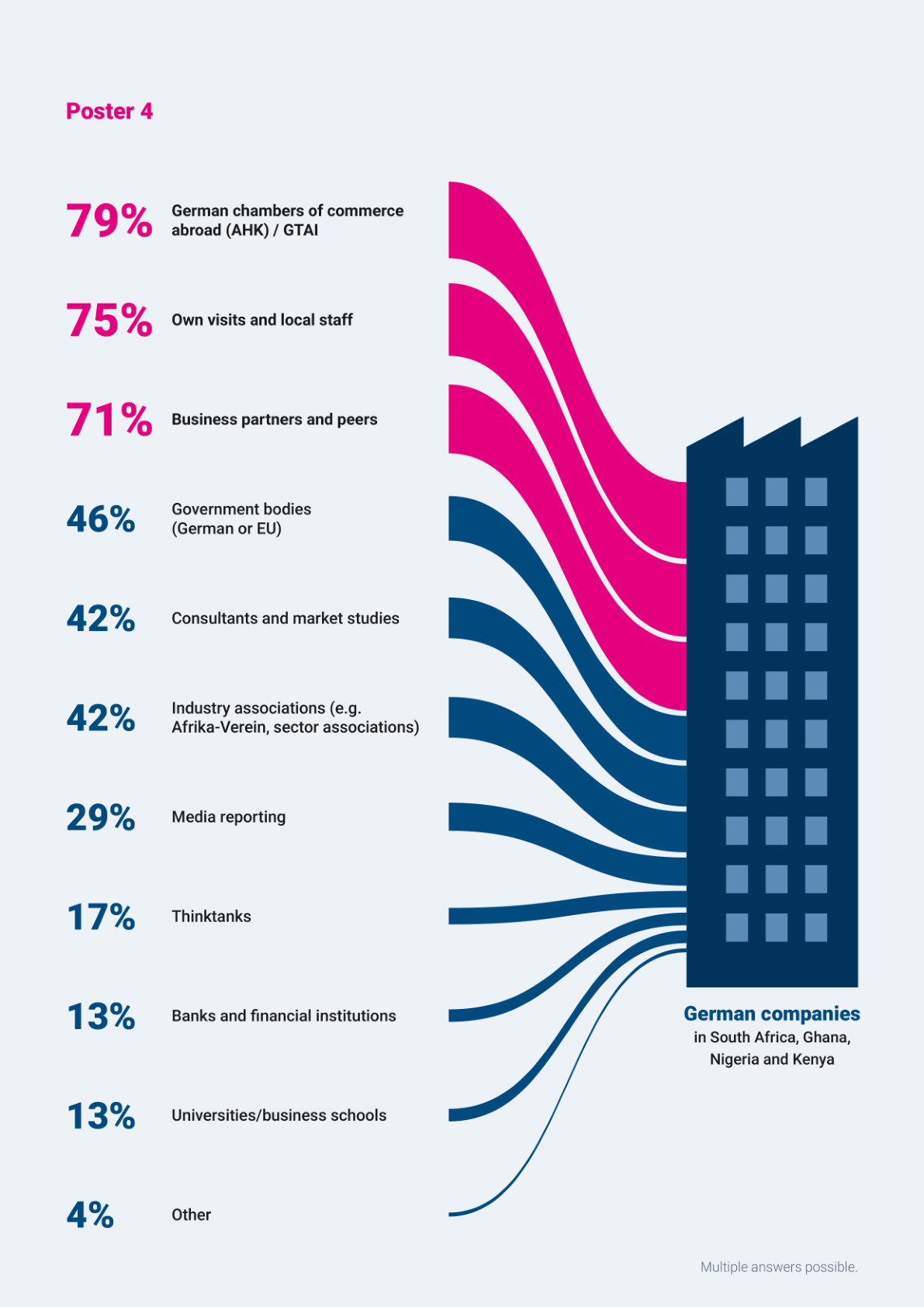
When asked to reflect on the information sources they use when “assessing African markets”, the top three were “own visits and local staff’, ‘German chambers of commerce abroad (AHK) / GTAI’ and “Business partners and peers’. The least consulted sources were “Banks and financial institutions’, ‘Thinktanks’ and “Universities/business schools’
Poster 3 presents the answers to the question, “We use the following support instruments”, where respondents could select: “Not aware; Aware but never used; Used but gained limited value; or Used, valuable”. For ease of reading, the highest response rate for each instrument was highlighted in bold (where the sample was split and two response categories received equal selection, both have been bolded).
4.3 Policies impacting the business environment
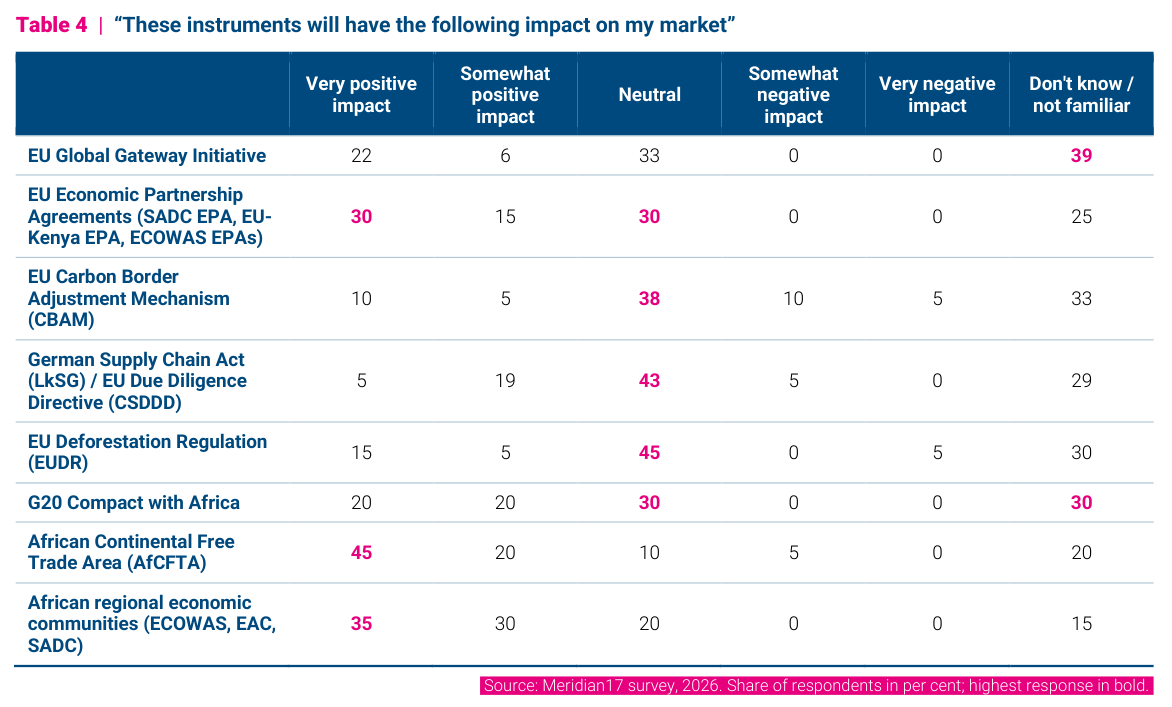
These instruments will have the following impact on my market. The results show a mixed set of responses, varying per instrument – with a range between having a very positive impact, to respondents not knowing of the initiative. For ease of reading, the highest response rate for each instrument was highlighted in bold (where the sample was split and two response categories received equal selection, both have been bolded).
4.4 Comparative market assessment and geopolitics
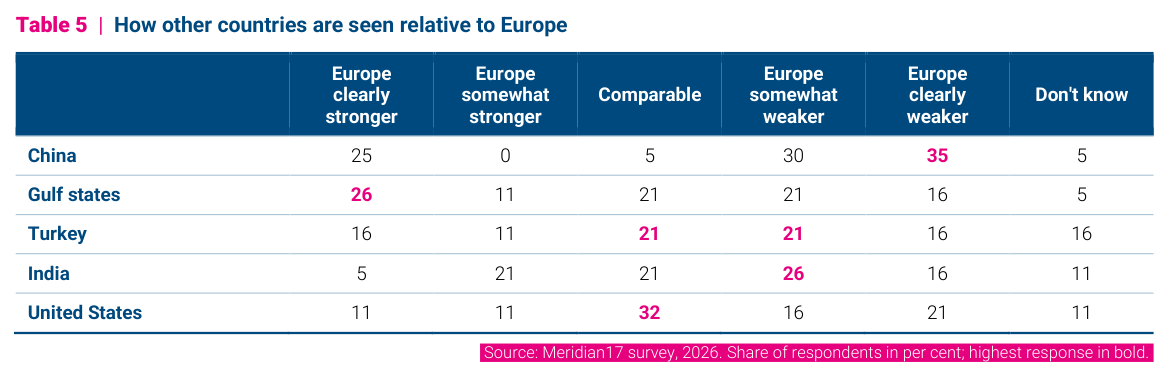
Reflecting on the way in which other countries are seen, relative to Europe, in each of the four markets, produced the following findings. For ease of reading, the highest response rate for each instrument was highlighted in bold (where the sample was split and two response categories received equal selection, both have been bolded).
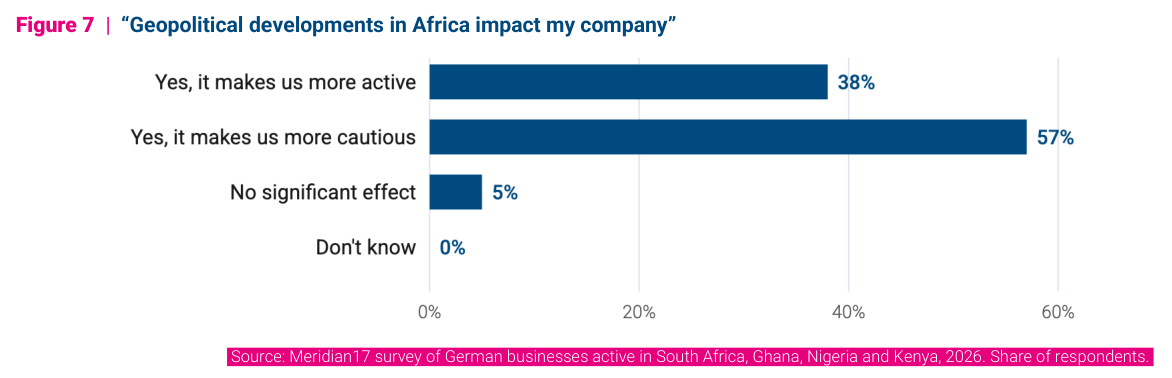
Where respondents were asked to reflect on how ‘geopolitical developments in Africa impact my company’, 57% of respondents noted that geopolitical developments increase their level of caution in their African operations
Three areas were ranked as the top three in response to the question ‘Germany and the EU should prioritise these THREE things to improve conditions in my market’. These were More ambitious trade agreements and market access (67% of responses), Support for SME market entry specifically (57% of responses), More consistent, long-term Africa policy (43% of responses). The lowest ranked were Visible flagship infrastructure projects (19% of responses) and Skills partnerships and vocational training (23% of responses). In addition two responses were provided for ‘other’ namely “Clearly prioritise countries with business friendly policies’ and “South Africa needs economic growth before demand for specialised healthcare services can increase.”
In response to an open question on “This is the biggest misunderstanding in Germany and/or Europe about doing business in Africa”, we received only a limited number of responses but these included:
- Financial risks,
- It is not "Africa" - it is 54 different countries, each with their own complexities, rules, and problems.,
- Respect for time,
- That free movement of goods, service and people will harm their economies,
- There are serious opportunities to be explored,
- Environment of business,
- Not having local solutions to the local environment rather they want to implement the European ways,
- That Africa is risky, unsafe and one cannot make profit,
- There is no “Africa”. There are 54 economies that cover the entire spectrum from BB- to AA+,
- Too much emphasis on risk ...,
- They're not waiting for us. China is seizing market shares and supporting
- Chinese companies penetrate the markets.,
- It is easy. It is not nearly especially for private sector and local collaborations is crucial,
- German and Europe seeing Africa as one big country while they are completely different markets
5. Making sense of the numbers
In this section, we take a closer look at the findings, and unpack them, to get a sense of the sentiment that business has across the four countries of operation.
Across the four markets, the share of global revenue that African operations represented was limited – with the majority of responses falling into the three categories of below 25%. This highlights that Africa is generally a piece of the broader business puzzle, but not the main focus of operation for these German businesses.
For most respondents, current expectations regarding the performance of their African businesses met or exceeded their expectations – an indication that the operating environment is robust. Given the geo-political challenges such as the war in Iran and associated impact on fuel and fertilizer costs (Vos, 2026), this is a positive position for the businesses in these countries.
This positive current position likely underpins the positive expectation for the year ahead and the next three years – where 26% of respondents expected revenue to remain stable in the coming 12 months, and a combined 73% expected that there would be an increase in revenue in that period. Furthermore, 50% of the respondents thought that the business environment in their market of operation was favourable or very favourable. This corresponds with Sililo (2026, personal communication) who noted the for German businesses globally, “Africa has, … the second most positive assessments, regarding all continents, internationally”.
Taken as a whole, with 44% of African operations’ global revenue share in the 5 – 25% bracket, current expectations being met or outperformed, and a strong positive view of the future in the coming 1 – 3 years, this is a positive picture for German businesses on the continent, indicating an appetite for growth.
This is good news for deepening ties between German business and these countries, but also places some responsibility on the four countries in the sample to ensure that they continue to effectively manage the geopolitical fallout – and should do so in tandem with German partners, where there are synergies to be leveraged.
5.1 But what’s holding business back?
Across the four countries, there was some overlap in the top three constraints as ranked by the respondents. Corruption and governance concerns were ranked first for South Africa, Ghana, and Kenya, and this was the second highest concern for Nigeria. Addressing corruption and state-capture is therefore a key area of improvement across the four sample countries. Policy and regulatory uncertainty was ranked first in Nigeria and third in Kenya, while Logistics, ports and transport infrastructure were an issue raised for Kenya (2nd) and South Africa (3rd).
South Africa had the unique constraint of Local-content, ownership or empowerment requirements, ranked 2nd – due to the local requirements for Broad Based Black Economic Empowerment. This echoes Moakes & Berkowitz (2026:6), who note that German stakeholders pointed to “the need for South Africa to create an enabling environment for foreign direct investment”, referencing BBBEE as one of the “common constraints”.
Given South Africa’s Apartheid history and high-levels of inequality and unemployment. The regulatory environment is tailored to attempt to address this historic and current inequity. However the investment decision of “are influenced greatly by policies, regulation and incentives at all tiers of government” and for many foreign firms, not only German business “the Broad-Based Black Economic Empowerment (BBBEE) legislation enacted by the [South African] government seems to be the major discussion point” (Kollamparambil & Jogee, 2018:240).
A World Bank (2024:9) report notes that “various industrial policies (such as the B-BBEE, local content requirements, and public procurement), though not explicitly targeting foreign companies, have significantly increased the cost of doing business in South Africa.” Regulations around empowerment is an area that has become increasingly contentious of late. For example at the 2025 Built Environment Indaba, the issue arose, with reporting on the discussion pointing out that, “numerous foreign would-be private sector investors have complained that South Africa’s BBBEE policies are anathema to a favourable foreign investment environment – the World Bank being only the latest example” (Parker, 2025). Parker continues to report that in “2018, the EU expressed reservations about South Africa's BBBEE ownership rules, deeming them "unfairly onerous".” (Parker, 2025: N.P.).
Ghana had the unique challenge of Reliability and cost of energy and water supply. This is confirmed by Kipkoech (2024:2) who points out that while Ghana is know for its political stability in the region, it has laboured under the weight of an energy crisis, “characterized by power cuts, erratic and embarrassing power shortages Highlighting the diverse energy mix in play in Europe, Debrah (2024) highlights in relation to Ghana’s energy challenges that “No industrialised nation developed its economy based on variable generation of electricity. They needed a reliable backbone that could be depended on at all times”. For both local companies in Ghana and German companies doing business there, “if Ghana wants to exploit its natural resources and become an industrial giant, it needs sustainable, reliable and affordable baseload electricity” (Debrah, 2024). Kipkoech notes that there is a focus on renewable energy in Ghana, and that “renewable energy capacity in Ghana is expected to grow substantially, in the years to come” (2024:18).
South Africa would here offer lessons for Ghana, as Moakes & Berkowitz (2026:12) note “Energy reform and the gradual stabilisation of electricity supply have been widely recognised as positive developments with significant implications for trade”
For Nigeria the unique constraint of Access to finance / currency convertibility and FX risk. According to Risk Advisory (2025), Nigeria has struggled with foreign exchange, due in part to “structural imbalances, policy inconsistencies and external shocks” (N.p.), which was exacerbated by the existence of a parallel/black market. Risk Advisory continue to note that reforms in three areas – floating currency, clearing the forex backlog and tighter Bureau De Change regulations have led to improvements in the system (2025).
For Kenya, after corruption, Logistics, ports and transport infrastructure were raised as the second most prominent constraint. Yet as Issa (2026, N.P.) reports, the port of Mombasa handled a record level of cargo in 2025, noting that “the growth underscores Kenya’s rising role as a regional logistics hub, supported by strong gains in container traffic and transit cargo” and further stated that “Cabinet Secretary for Investment, Trade and Industry Lee Kinyanjui said the government is intensifying efforts to enhance efficiency at the Port of Mombasa as part of a broader strategy to strengthen Kenya’s competitiveness in regional and global trade” (Issa, 2026, n.p.). This is movement in the right direction, to remove or alleviate this constraint.
What our African sample countries can do to invite investment
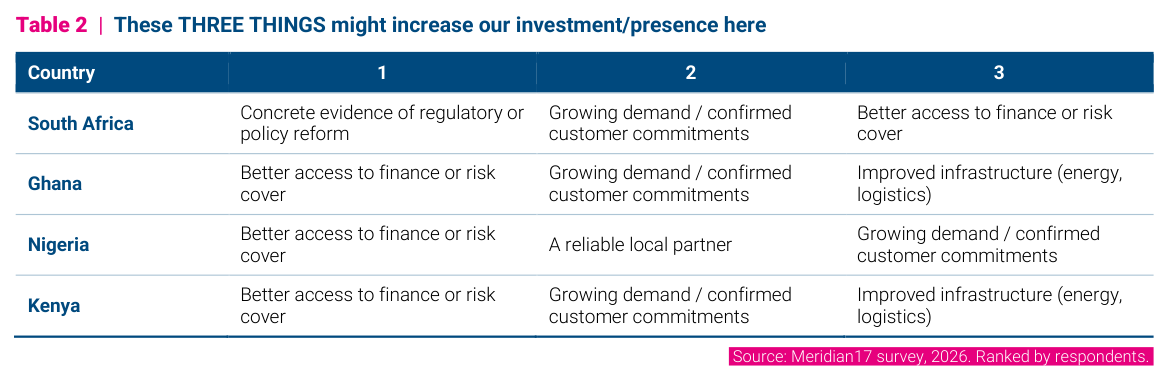
There was again a fair amount of overlap between the countries in the areas in which respondents believed that changes would increase the level of investments that they had in the respective countries of operation. Better access to finance or risk cover, and Growing demand / confirmed customer commitments were mentioned for each of the four countries.
Considering Risk, Dr Adesina President of the AFDB, noted in 2025 that “Africa's risk is not different from any part of the world". He continued to note that;
“WE ACTUALLY ASKED MOODY’S ANALYTICS TO LOOK AT THE RISK PROFILE OF AFRICA, OF INVESTMENTS AND INFRASTRUCTURE OVER THE LAST 14 YEARS. GUESS WHAT THEY FOUND? THE RATE OF LOSS IN AFRICA IS 1.7%. THAT IN LATIN AMERICA WAS ABOUT 13%. THE ONE IN EASTERN EUROPE WAS MORE ABOUT 10%.” (AFDB, 2025, N.P.)
Similarly Afrika Verein call for a “rethink [of] risk perceptions of African markets” (2026: N.p.), and note that this rethink should “support the … possibility of granting local currency loans.” Afrika Verein (2026: N.p.), continue to state that “guarantee components for local banks (e.g., through DEG, KfW, Euler Hermes) could enhance the competitiveness of German projects in many regions” (Afrika Verein, 2026: N.p.). This perception of risk, and the associated cost to African economies, is discussed in a 2024 study by Africa No Filter (Africa No Filter, 2024). This report highlights that “if media sentiment levels were more realistic about Africa, the interest rate for borrowing money would also decrease. This would result in African countries paying much less money over time to repay their loans.” (Wilke et al., , 2024:21)
Despite this risk perception, 50% of respondents expressed that they planned to expand their existing business in the coming months, and as it pertains to the next three and ten years, 52% and 45% respectively of respondents expected entry into new African markets. Overall, the picture across all respondents was positive towards the future and therefore indicates a need to focus on strengthening the relationship between German business and these four African countries – to ensure that this growth and expansion materialises, and to facilitate strong local positions for expansion.
The impact of perception
Respondents to the survey found some consensus in that the reporting of African business opportunities in the four countries was either ‘a little’ or ‘far too’ negative – indicating a disconnect between the media and the business realities that they experienced in their work.
This is supported by, for example Africa No Filter, who note that “The media’s portrayal of Africa has long been dominated by persistent stereotypes”. This includes a disproportionate amount of airtime and focus on violence, political risk and economic risk and uncertainty (Africa No Filter, 2024, N.p). This is confirmed by Sililo (2026, personal communication) who states, “the image that we have of Africa as a continent in Germany … if you don't travel regularly to Africa, you get, you have a wrong idea in your head. And, … African related news [plays] a big role if you … consume the regular news or the main media outlets”.
This impacts investor sentiment and of course, this discussion relates to the section above on risk above.
Moving from the media more generally, we aimed to find out which sources of information German businesses turn to when they assess African markets. The most reported source was German chambers of commerce abroad (AHK) / GTAI’, followed by “Business partners and peers’ and then ‘own visits and local staff’. This highlights, as one opportunity to change negative perspectives, the role of bringing German businesses with potential interest in the African continent, to visit the relevant countries in person, and to engage closely with other industry professionals – both German and local to the African host country.
As Sililo (2026, personal communication) points out regarding infrastructure, “if you look at … some areas in Morocco, some areas in Nairobi, there have been tremendous improvements, and [if] the last time that you were in Africa was, like, I don't know, 15 years ago, for example, if you're a decision maker, in a small and medium-sized company, and perhaps backpacking through Africa in your early 20s, you have the wrong idea”
Still within the information landscape, we were curious to learn more about the perception various support instruments that exist to support or deepen the work of German businesses in African countries. The two most reliable and valuable sources were seen to be the “AHK network (German chambers abroad)” and “German embassies”. At the other end of the spectrum are the instruments where awareness is lacking – and interestingly the EU instruments such as the Global Gateway Initiative (GGI) – which is targeted at just this group of organisations, had the greatest awareness gap of all options. The GGI, for example, is tailored to bring about closer engagement between the EU and the private sector.
For the EU, this finding serves to reinforce the call for greater transparency and engagement with business, a call that has been resounding for several years now (Bilal, 2022).
5.2 How existing support instruments can be sharpened for impact
When we asked respondents to identify the impact that they expected several policy instruments to have on their African market of operation. Again it emerged that the EU GGI was not widely known, while the EU Economic partnership agreements were largely viewed favourably to neutral, in their impact. Other EU regulations such as CBAM, CSDDD or the EUDR saw respondents cluster in the ‘neutral’ impact on their markets, with a large amount of lack of familiarity with these policies. The picture for the G20 Compact with Africa was more nuanced, with a fairly even spread of responses across positive impacts, neutrality and a lack of awareness. What is interesting and encouraging to see is that African policies such as the AfCFTA and the RECS were generally seen in a positive light.
This is interesting as the impact of the policies varies across the selected countries. For example, CBAM is expected to have different impacts in South Africa compared to Kenya (Alexander et al, 2024) where the impact in South Africa is expected to be negative (Herbert, 2026). Furthermore in Ghana, the EUDR bears directly on cocoa, yet awareness among smallholders remains limited, so neutrality of responses may signal a sectoral focus of respondents (Ofosu & Abba, 2026). Similarly in Nigeria, CBAM exposure is concentrated in a small set of industrial exports rather than the oil and gas that dominate EU trade (Oshota, 2026). Oshota (2026:51) here calls for “strengthening trade diplomacy through AfCFTA and EU-Africa partnership frameworks”
5.3 The EU vs the ‘rest’, how the EU measures up
Across the four markets, our results show that the EU is seen as ‘clearly weaker’ than China, somewhat weaker than India, comparable to the United States, and ‘clearly stronger’ than the Gulf States. Respondents were split evenly when it came to Turkey, reflecting that Europe was ‘comparable’ or ‘somewhat weaker’ to Europe. This indicates that Europe, and by extension Germany, needs to improve it’s positioning in the four African countries, and respond to the geopolitical competition unfolding across African markets. This aligns with the finding above, where there are European resources dedicated to projects and market development in African countries, but the level of awareness is limited. Similarly, this reinforces Moakes & Berkowitz (2026:13) who note that China “are offering faster financing, infrastructure delivery and less stringent regulatory conditions”.
Furthermore, as respondents reflected on how ‘geopolitical developments in Africa impact my company’, 57% of respondents noted that geopolitical developments increase their level of caution in their African operations. The war in Iran and resulting fuel prices increases, which also drove up the price of fertilizer; Russia’s ongoing war in Ukraine (Gumede, 2026), US tariffs , and the “global trend of cutting foreign aid and waning international solidarity” (Van Cauwenbergh, 2026:N.P.) all have an impact on African markets.
Looking to see areas of improvement, when asked to reflect on the question ‘Germany and the EU should prioritise these THREE things to improve conditions in my market’ – the top responses were, ‘More ambitious trade agreements and market access’, ‘Support for SME market entry specifically’, ‘More consistent, long-term Africa policy’. These all point to the ‘Afrikawende’ called for by SAFRI (Sililo, 2025). At a policy level the Afrikawende advocates that “Germany must realign its Africa policy – with clear priorities and measurable steps” (Sililo, 2025:N.P.). Similarly Foreign Minister Wadephul (2026) notes that “relations between Europe and Africa are of strategic importance” and has invested time in building deeper relations – particularly with South Africa and Nigeria.
5.4 Misunderstandings in Germany/EU about doing business in Africa
Diving into respondent’s views of the “the biggest misunderstanding in Germany and/or Europe about doing business in Africa”, one respondent said they were “Not sure’ and the remainder of responses can be sorted into the following categories.
Perception
This category includes comments that point to the negative perception of African countries, and that holds German and European companies back from investing. The third comment also points to the high-regard that German solutions are held in, and that these solutions are desirable. The final point speaks to the perception clouding the opportunity assessment
- That Africa is risky, unsafe and one cannot make profit,
- Too much emphasis on risk ...,
- Financial risks
- Not having local solutions to the local environment rather they want to implement the European ways,
- There are serious opportunities to be explored,
Homogenisation
This category focuses on the way in which ‘Africa’ is seen as a single entity and not understood for the diversity of markets that it represents. The point about ‘environment of business’ is included here, to reflect the lack of clarity on what that environment encompasses.
- It is not "Africa" - it is 54 different countries, each with their own complexities, rules, and problems.,
- Environment of business,
- There is no “Africa”. There are 54 economies that cover the entire spectrum from BB- to AA+,
- German and Europe seeing Africa as one big country while they are completely different markets
Competitive environment
The third category reflects the misunderstanding in the area of competition, For example not recognise that African partners are not waiting for the EU but are moving on with China for example. Points three and four point to the need to spend time and be patient to work through challenges, in order to reap the rewards of operating in Africa. The last point refers to a level of caution in the EU and with German
- Chinese companies penetrate the markets,
- They're not waiting for us. China is seizing market shares and supporting,
- It is easy. It is not nearly especially for private sector and local collaborations is crucial,
- Respect for time,
- That free movement of goods, service and people will harm their economies,
Taken as a whole, these themes point to the necessity of gaining greater understanding of the complexity and nuance of the various countries and markets and the regional blocs. And while AfCFTA attempts to integrate these markets, it will not alter the unique character of each.
5.5 Market surprises
Looking at the surprises that respondents noted about doing business in Africa, three main themes emerged.
Potential
This category refers to the positive potential in doing business in the African markets included in the study. Respondents noted, “My usual recipes for growth that were successful in other markets did not work in South Africa. Business is much harder, but also patience and stamina are rewarded.” Another noted, “Product acceptance and acquisition” while a third indicated “The opportunities are boundless.”
Volatility
This category links to the geopolitical discussion above, with respondents stating, “The significant impact of far off geo-political issues on the local economy ( USA-Iran war, the Russia-Ukraine war)” one pointed to “Forex fluctuations” and another respondents noted “Very volatile market and sensitive to geopolitics”.
Within this category, there is also the local level of volatility, with a respondent pointing to “The entrenched level of corruption present in all these markets” and “Unpredictable regulatory environment”. This is evident in, for example, Transparency International’s Corruption Perception Index (2026). Similarly Munda (2025) and Nwachukwu (2026) highlight the impact of regulatory uncertainty in Kenya and Nigeria.
Understanding/cooperation
The final category looks at the need to engage with and deepen cooperation, as one respondent notes their biggest surprise in the market they operate in is “Mistrust towards anything foreign, even though the services are needed and certifications proving trustworthiness are available.” This points to the need to unpack and deepen communication, build shared standards and develop the requisite understanding to strengthen and accelerate partnership.
A second response in this category notes:
“I REPRESENT GERMANY IN KENYA AND THOUGH IT HAS BEEN DIFFICULT I CAN SEE PROGRESS. STILL NEED FOR ACCESS TO MARKETS IN GERMANY IN TERM AS OF PRIVATE SECTOR LINKAGES TO COMPANIES THAT WE CAN SUPPORT WITH LABOUR PLANNING AND FUTURE OF SKILLS. KENYA HAS TALENT BUT WE NEED MORE PRIVATE SECTOR FROM GERMANY OPENING OPPORTUNITIES AND COLLABORATING WITH A FELLOW GERMAN COMPANY WITH SUCCESS”
This points to the potential not only for German businesses to develop skills locally, but also to partner with other German business in each market, to strengthen the ecosystem and leverage shared ties to boost business opportunities.
6. Looking ahead
Looking ahead, the findings are generally positive for the direction of German-African business cooperation. Sillio (2026, N.P.) notes that there is improvement in terms of perception of Africa, by “German companies and the German government … So, I think the image of Africa is improving, [because] people are seeing, … in certain areas in Africa, things are really, you know, moving forward and are being improved”. He continues to highlight that “politically speaking, I think political decision makers and also the ministries, they have understood the importance of Africa”. Those who are already active on the continent have an awareness of the skills and mindset needed to thrive and there is a consistent picture of long-term engagement, planned investments and continues presence.
Areas that present a challenge to business seem, in many cases, to be slowly improving and to be showing some progress and movement in a positive direction. The biggest challenges are the classic VUCA (Volatility, Uncertainty, Complexity and Ambiguity) issues that arise. These may include climate change, adverse climate impacts, safety and security. These will require a broad-based partnerships to address. Similarly geo-political events will need to be actively managed as they arise – and resilient solutions found. In both of these cases, there is a need for partnership, and there is the potential to deepen cooperation between Germany and it’s African partners in developing and implementing solutions in response to these changes.
Furthermore there is an awareness that the media portrayal of the African markets is not neutral, and may be shaping the way in which German businesses view opportunities in African markets. This is a critical revelation and the first, encouraging, step to changing that perception, and consequently driving deeper engagement between German business and their African counterparts.
7. Recommendations
Below we present five key recommendations for advancing the Germany- South Africa / Kenya / Ghana / Nigeria relationship.
Firstly, make Global Gateway visible to business through trusted, established channels. As we saw, 39% of respondents were unaware of the EU instruments that are available to them, and fee respondents found these instruments valuable. However 63% found the AKH network valuable and 57% saw value in the German embassies. By drawing GGI projects closer to these institutions, paired with project and tender pipelines, there will be a clear and single source of information for German companies. One step further would be for these institutions to vet and actively engage with local partners, who may serve to speed up implementation and offer local knowledge.
Secondly, to rethink and redesign the finance and risk cover available for firms. Improved access to finance or risk cover appears in the top-three investment triggers in all four countries. For example 61% of respondents were aware of Hermes cover but have not used it, representing a missed opportunity. Guarantees for German SMES should be tailored and simplified, with local-currency lending options, guarantee components for local banks – as per the Afrika-Verein suggestion.
The third recommendation would be to develop a user-friendly SME entry package. We see that 57% of respondents wanted a SME-specific market-entry support and reliable local partners. AHKs and GTAI, together with embassies could develop a vetted-local partner matchmaking service to facilitate entry. Respondents indicated that their own visits to the countries and local staff in country are critical to developing a sense of the markets and what comes next.
Fourth, we recommend that German decision-makers are invited to see African markets for themselves. Germany and the EU, working with the AHK network, embassies and African host governments and chambers, should fund and organise short, sector-specific visits for German executives who are interested in Africa but not yet active there. Respondents reported relying most on their own visits, local staff and peers when assessing markets, and over half (54%) find German media coverage too negative. Firsthand exposure, including meetings with local partners and German firms that already operate in these markets, is therefore one of the most direct ways to close the perception gap. These visits should be country-specific rather than ‘Africa tours’, so participants see how the four markets differ. This is vital, not only for German businesses already active on the continent, but also those who are not yet active, but investigating adopting a position on the continent.
And finally, to replace the single “Africa” narrative with country-level evidence. 54% of respondents noted that the German media debate too negatively depicts the African context, and only 30% find it accurate. Many of the open comments noted that “there is no Africa”. We recommend publishing short, country-specific risk-and-opportunity briefs and case-studies of success, through the AHKs, and engage banks and financial institutions more directly, since respondents consult them least when assessing markets. This is critical in developing the nuance required to navigate the complexity of the markets, coupled with the broader AfCFTA, which seeks to integrate these markets.
8. Conclusion
This study shares findings that focus on the German view of the business environment in South Africa, Kenya, Nigeria and Ghana. We find that there is a generally positive view of the future of respondents’ organisations in their respective African markets. There is also a consensus that there is a need to alter the narrative regarding the business opportunities in Africa. This also extends to the need to de-homogenise the continent, and to look at each country and potential market on a case-by-case basis. However there is also a clear understanding that there is a different mindset required when doing business in these markets – for example, a longer-term view, a more resilient approach and a deep understanding of the context.
We therefore see this as a positive contribution, not only in further closing the information gap that exists between German businesses and these four African markets – but also in terms of sharing a positive outlook. African countries, including those in the study, are not immune to global challenges and geo-political upheaval, but we have shown that they are resilient and able to withstand these shocks. Similarly, while many challenges remain in improving the business and operating environments of these countries, there is evidence of progress across the board.
Finally, our results showed that many support instruments available to German businesses were not fully utilised, or that there was a general lack of awareness that these were available. This provides useful guidance for these instruments and institutions to revise or revisit their engagement with German business in order to fully leverage their capabilities in doing business in these African countries.
We therefore would like to close by thanking the respondents who took the time to complete the survey and share their insights, which have helped us to gain deeper insight on the current state of the game as well as where to next, for German businesses in these markets.
References
African Business. (2024, June 10). African consumers remain loyal to non-African brands. https://african.business/2024/06/dossier/african-consumers-remain-loyal-to-non-african-brands
African Development Bank. (2025). Africa’s risk premium: A costly myth holding back a continent. https://www.afdb.org/en/news-and-events/press-releases/africas-risk-premium-costly-myth-holding-back-continent-80966
Afrika-Verein der Deutschen Wirtschaft. (2026, May). New impulses for business and investment in Africa [Policy paper]. https://afrikaverein.de/wp-content/uploads/2026/05/New-Impulses-for-Business-and-Investment-in-Africa_final_EN.pdf
Alexander, K., Dos Santos-Ford, T., & Wachira, M. M. (2024). Shifting Tradewinds: The implications of CBAM in SA and Kenya [Whitepaper]. Gordon Institute of Business Science. https://content.gibs.co.za/cmscontent/media/wp2pflt1/alexande r_shifting-tradewinds_the-implications-of-cbam-in-sa-and-kenya.pdf
Altman, S. A., & Bastian, C. R. (2026). DHL global connectedness report 2026. DHL Group. https://doi.org/10.58153/rm518-hve77
Beckley, M. (2025, November). The stagnant order: And the end of rising powers. Foreign Affairs, 104, 8–27. https://www.proquest.com/magazines/stagnant-order-end-rising-powers/docview/3264709843/se-2
Bilal, S. (2022, December 2). The EU Global Gateway – One year in: How to partner with the private sector? European Centre for Development Policy Management. https://ecdpm.org/work/eu-global-gateway-one-year-how-partner-private-sector
Bougrea, A. (2025). The European Investment Bank in sub-Saharan Africa: Constrained expansion. Journal of Economic Policy Reform, 28(1), 12–36.
Debrah, S. K. (2024, July 9). Ghana is planning its first nuclear energy plant: What’s behind the decision. The Conversation. https://theconversation.com/ghana-is-planning-its-first-nuclear-energy-plant-whats-behind-the-decision-232022
Erlanger, S. (2026, October 20). It’s not just France. Europe’s political center is crumbling. The New York Times. https://www.nytimes.com/2026/10/20/world/europe/france-protests-europe-centrist-far-right.html Federal Ministry for Economic Cooperation and Development.
(2026a). Ghana. Retrieved 8 October 2026, from https://www.bmz.de/en/countries/ghana Federal Ministry for Economic Cooperation and Development.
(2026b). Kenya. Retrieved 8 October 2026, from https://www.bmz.de/en/countries/kenya Federal Ministry for Economic Cooperation and Development.
(2026c). Nigeria. Retrieved 8 October 2026, from https://www.bmz.de/en/countries/nigeria Federal Ministry for Economic Cooperation and Development.
(2026d). South Africa. Retrieved 8 October 2026, from https://www.bmz.de/en/countries/south-africa
Gumede, W. (2026, October 23). Oil crisis global short. Mail & Guardian. https://mg.co.za/thought-leader/2026-10-22-oil-crisis-global-short/
Herbert, I. (2026, January 28). South Africa must decarbonise and diversify to save its vital German trade. Daily Maverick. https://www.dailymaverick.co.za/opinionista/2026-01-28-south-africa-must-decarbonise-and-diversify-to-save-its-vital-german-trade/
International Monetary Fund. (2026). Ghana [Country page]. Retrieved 8 October 2026, from https://www.imf.org/en/countries/gha
Issa, K. (2026, January 30). Port of Mombasa cargo volumes hit record 45.45 million tons in 2025. Khusoko. https://khusoko.com/2026/01/30/port-of-mombasa-cargo-volumes-hit-record-45-45-million-tons-in-2025/
Kipkoech, R., Takase, M., Ahogle, A. M. A., & Ocholla, G. (2024). Opportunities and challenges in Ghana’s renewable energy sector. Discover Applied Sciences, 6(10), Article 530.
Kollamparambil, U., & Jogee, R. (2018). Johannesburg: Interlinked narratives and investment by foreign firms. In R. Wall, D. Nyamai, A. Asubonteng, S. Grafikos, A. Gianoli, & S. Stavropoulos (Eds.), The state of African cities 2018: The geography of African investment (pp. 192–204). UN-Habitat. https://unhabitat.org/sites/default/files/download-manager-files/The%20State%20of%20African%20Cities.pdf
Moakes, J., & Berkowitz, P. (2026, January). The South Africa- Germany trade relationship [Report]. Friedrich Naumann Foundation for Freedom. https://www.freiheit.org/publikation/south-africa-germany-trade-relationship
Munda, C. (2025, May 8). Unpredictable policies now biggest investor concern in Kenya. Business Daily. https://www.businessdailyafrica.com/bd/economy/unpredictable -policies-now-biggest-investor-concern-in-kenya-5535380
Nwachukwu, V. (2026, July 8). Manufacturers decry impact of multiple taxation, policy uncertainty. The Guardian (Nigeria). https://guardian.ng/business-services/industry/manufacturers-decry-impact-of-multiple-taxation-policy-uncertainty/
Obulutsa, G. (2026, July 10). Kenya’s economic growth stays around 5% in first quarter. CNBC Africa. https://www.cnbcafrica.com/2026/kenyas-economic-growth-stays-around-5-in-first-quarter
Ofosu, A. A., & Abba, M. (2026). Europe’s deforestation law tests Ghana’s cocoa farmers, spares its gold miners. Africa Sustainability Matters. https://africasustainabilitymatters.com/europes-deforestation-law-tests-ghanas-cocoa-farmers-spares-its-gold-miners/
Okebiorun, O. (2026). Ghana set to overtake Ethiopia as Africa’s eighth-largest economy, leading by $1.49 billion in latest IMF projections. October 17, 2026. Business Insider Africa. https://africa.businessinsider.com/local/markets/ghana-set-to-overtake-ethiopia-as-africas-eighth-largest-economy-leading-by-dollar149/rkm2gtw
Okpi, A. (2025, August 15). Factsheet: Nigeria rebases its economy again – Here’s what sets it apart. Africa Check. https://africacheck.org/fact-checks/factsheets/factsheet-nigeria-rebases-its-economy-again-heres-what-sets-it-apart
Oshota, S. O. (2026). Carbon border adjustment mechanisms (CBAM), Nigeria’s export structure, and the green trade transition challenge. Economic and Policy Review, 24(1), 46–55. https://www.ajol.info/index.php/epr/article/view/332258
Parker, D. (2025, March 4). We want more investment but we will not relax BBBEE, Construction Sector Charter Council says. Engineering News. https://www.engineeringnews.co.za/article/we-want-more-investment-but-we-will-not-relax-bbbee-construction-sector-charter-council-says-2025-03-04
Risk Advisory. (2025). The high cost of foreign exchange: How Nigeria’s FX shortage has impacted both businesses and everyday life. https://riskadvisory.com/news/the-high-cost-of-foreign-exchange-how-nigerias-fx-shortage-has-impacted-both-businesses-and-everyday-life/
Scholz, O. (2023, January). The global Zeitenwende: How to avoid a new Cold War in a multipolar era. Foreign Affairs, 102, 22–38. https://www.proquest.com/magazines/global-zeitenwende-how-avoid-new-cold-war/docview/2761235632/se-2
Sherriff, A., & Veron, P. (2024). What is driving change in Europe’s international cooperation agenda? Part 1. European Centre for Development Policy Management.
Sililo, T. (2025, October 16). Shaping the Africa transformation now: SAFRI presents concrete demands for a new Africa policy [Press release]. SAFRI. https://safri.de/pressemitteilung-afrikawende-jetzt-gestalten/ Southern African-German Chamber of Commerce and Industry &
Germany Trade & Invest. (2026). German-Southern African business outlook 2026 [Report]. AHK Southern Africa. https://www.gtai.de/resource/blob/2009190/a3bbfc41d37d7224 21eeea50122a52c2/2026%20Business%20Outlook%20Report.pd f
Transparency International. (2026, February 10). Corruption Perceptions Index 2025: Public sector corruption sees Sub-Saharan Africa face the highest corruption levels globally [Press release]. https://www.transparency.org/en/press/corruption-perceptions-index-2025-public-sector-corruption-sub-saharan-africa-face-highest-corruption-levels-globally
Van Cauwenbergh, L. (2026, February 19). Main challenges facing Sub-Saharan Africa in 2026 and beyond. Credendo. https://credendo.com/en/knowledge-hub/main-challenges-facing-sub-saharan-africa-2026-and-beyond
Vos, R. (2026, June). Iran war: From fertilizer to food crisis. Welthungerhilfe Global Food Journal. https://www.welthungerhilfe.org/global-food-journal/rubrics/crises-humanitarian-aid/iran-war-from-fertilizer-to-food-crisis
Wadephul, J. (2026, July 20). [Title of statement]. Federal Foreign Office. https://www.auswaertiges-amt.de/en/newsroom/news/2779132-2779132 Wilke, M., Ferreira, M., Mashita, C., Shah, S., Joffe, S., Adjignon, S., &
Hagos, L. (2024). The cost of media stereotypes to Africa. Africa No Filter. https://africanofilter.org/evidence/media/the-cost-of-media-stereotypes-to-africa/
World Bank. (2024). Driving inclusive growth in South Africa. http://documents1.worldbank.org/curated/en/099030525063547 256/pdf/P180069174d7f60701bf2f1de50aa4f9835.pdf
About the Authors
Dr Kelly Alexander is President of Meridian17 and lectures on Strategy & Sustainability at GIBS Business School. A social scientist, she analyses geopolitical shifts and integrates sustainability into economic development. She holds a PhD in Management & Organisation Studies from Tilburg University.
Benjamin Livestro is an expert at Meridian17, focussing on geopolitical developments. He holds an MA in History from Utrecht University and an MBA from Rotterdam School of Management.
Publication credits
Published by Friedrich Naumann Foundation for Freedom, Regional Office Africa, Weber House, 50 Ennis Road, 2193 Parkview, Johannesburg, South Africa
freiheit.org/sub-saharan-africa
Authors Dr Kelly Alexander, Benjamin Livestro, Meridian17, Africa–Europe think and do tank, “Research Report on Africa–Germany Business Relations” (November 2026)
Contact Telephone: +49 (0)30 2201 2634, Fax: +49 (0)30 6908 8102, E-mail: service@freiheit.org
Last update November 2026
Licence Creative Commons (CC BY-NC-ND 4.0)
Notes on using this publication This publication is an information service of the Friedrich Naumann Foundation for Freedom. The publication is available free of charge and is not intended for sale. It may not be used by political parties or election workers during an election campaign for the purpose of election advertising (federal, state and local elections as well as elections to the European Parliament).